Warehouse Safety: OSHA Racking Inspection Checklist
January 6, 2025
OSHA fines for warehouse safety violations can reach $161,323 per serious violation in 2025. That’s not a typo—and it’s not a distant risk. Warehouse racking failures happen, and when they do, the consequences are severe: injuries, operational shutdowns, and financial penalties that can cripple a business.
Here’s the reality: many warehouse managers don’t realize pallet racking requires regular inspection until an OSHA inspector shows up or—worse—until a rack collapses. Damaged racking creates collapse risk, injury liability, and steep fines.
The good news? Most violations are preventable with regular inspections and basic maintenance. In this guide, you’ll learn OSHA requirements for pallet racking, a detailed inspection checklist, how often to inspect, and what to do when you find issues.
OSHA Requirements for Pallet Racking
OSHA doesn’t have a specific “pallet rack standard,” but they do enforce several regulations that apply to warehouse racking systems.
Key OSHA Standards
1. 29 CFR 1910.176 – Handling Materials (General Requirements for Storage)
This regulation requires safe stacking, securing, and maintaining storage areas. It applies directly to pallet racking stability and load limits.
2. 29 CFR 1910.22 – Walking-Working Surfaces (General Requirements)
This standard requires floors and work surfaces to be kept in safe condition, which includes maintaining adequate aisle clearance around racking systems.
3. ANSI MH16.1 Standard (Referenced by OSHA)
The American National Standards Institute (ANSI) publishes standards for rack design, installation, and use. OSHA inspectors frequently cite ANSI MH16.1 during warehouse inspections. This standard requires load capacity placards, proper anchor bolts, and regular inspections.
4. RMI (Rack Manufacturers Institute) Guidelines
RMI publishes industry best practices for pallet rack safety, including recommendations for annual professional inspections and frequent internal checks. OSHA inspectors often reference RMI standards when evaluating warehouse racking.
The General Duty Clause
Even when specific standards don’t apply, OSHA enforces the General Duty Clause (Section 5(a)(1)), which requires employers to provide a workplace free from recognized hazards.
Bottom line: Damaged or overloaded racking is a recognized hazard. If OSHA finds it, you’ll get cited.
Inspection Checklist: What to Look For
Use this checklist for both internal inspections and preparing for external audits.
Structural Damage (Uprights, Beams, Bracing)
What to check:
- Bent or twisted uprights (vertical columns)
Even minor bends can reduce load capacity by 50% or more. Look for impact damage from forklifts, especially near floor level where collisions are most common. - Missing or damaged beams (horizontal load-bearing members)
Check that beams are fully engaged with uprights and properly locked in place. Look for bent, cracked, or rusted beams. - Loose or missing bolts (connections between uprights and base plates)
Anchor bolts should be tight and fully seated. Missing or loose bolts compromise stability. - Cracked welds or frame members
Any visible cracks are an immediate red flag. Cracked welds indicate structural failure. - Damaged bracing (diagonal supports on back and sides)
Bracing prevents rack sway and collapse. Missing or damaged bracing must be replaced immediately.
OSHA concern: Structural damage compromises load capacity and stability, leading to collapse risk.
Action: Red-tag and unload damaged sections immediately. Do not use until repaired or replaced by a qualified installer.
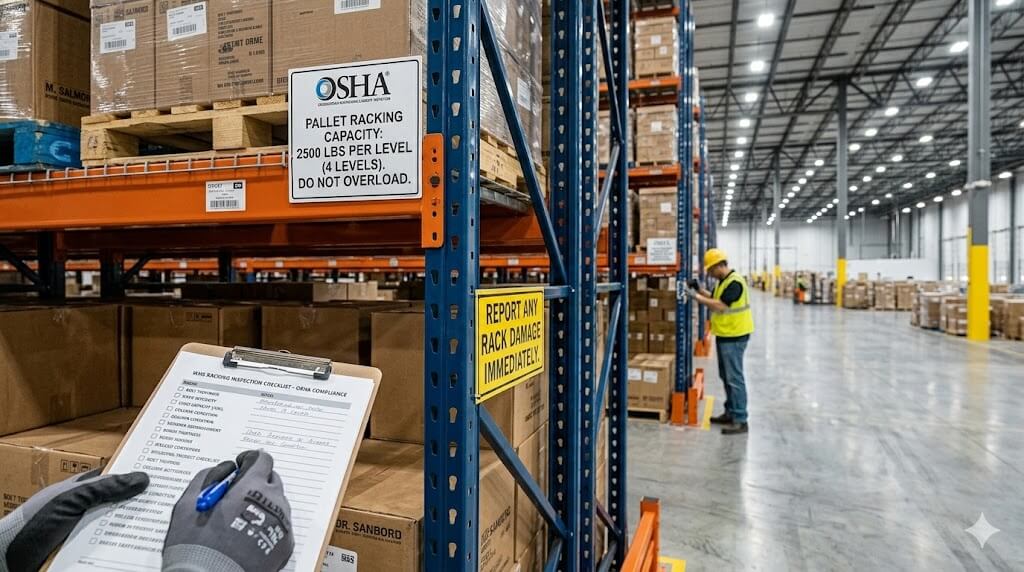
Load Capacity Labels (Must Be Visible and Accurate)
What to check:
- Load capacity placards must be posted on every rack or rack section
Labels should display the maximum load per beam level and per bay. They must be visible and legible—not faded, covered, or removed. - Labels must reflect actual current configuration
If you’ve modified racks (added or removed beams, changed beam spacing), labels must be updated to reflect the new capacity.
OSHA requirement: Load capacities must be clearly posted to prevent overloading. Failure to post accurate labels is a violation.
Common violation: Missing, illegible, or inaccurate labels—especially after rack modifications.
Action: Replace missing or damaged labels immediately. If your rack configuration has changed, consult the rack manufacturer or a structural engineer to recalculate capacity and update labels.
Overloading (Weight Limits, Uneven Loads)
What to check:
- Are pallets within posted weight limits?
Weigh random pallets to verify. Many warehouses estimate weight and guess wrong, leading to dangerous overloading. - Is weight evenly distributed?
Heavier items should be stored on lower levels to lower the center of gravity and improve stability. Uneven loading can cause tilting or rack failure. - Are pallets stacked safely?
Check for overhanging loads, unstable stacks, or unsupported weight that could shift or fall.
OSHA concern: Overloading is a leading cause of rack collapse, which can result in serious injury or death.
Action: Implement load monitoring procedures. Train staff on weight limits and proper loading techniques. Post reminders near loading areas.
Anchor Bolts (Must Be Secure, Not Loose)
What to check:
- All base plates must be anchored to the floor
Anchor bolts should be tight and properly installed. Missing or loose bolts lead to rack instability. - Floor condition around anchors
Cracks or spalling (chipping) around anchor points reduce holding power and weaken the connection. Uneven floors can stress anchor connections.
OSHA concern: Un-anchored or improperly anchored racks can tip or shift under load, leading to collapse.
Action: Tighten loose bolts immediately. Replace missing bolts. Repair damaged flooring around anchor points to restore structural integrity.
Aisle Clearance (OSHA Width Requirements)
What to check:
- Minimum aisle width for safe forklift operation
OSHA doesn’t specify exact aisle widths, but requires “adequate clearance” for equipment. Industry standard is:
Aisle width = 2x (forklift width) + pallet overhang + 12-18 inches clearanceTypical widths:- Counterbalance forklifts: 10-13 feet
- Reach trucks: 8-10 feet
- No obstructions in aisles
Pallets, equipment, or debris must not block aisles or create bottlenecks.
OSHA concern: Narrow or blocked aisles increase collision risk and slow emergency egress.
Action: Measure aisles and mark clear boundaries. Enforce aisle clearance policies to prevent obstructions.
Column Protectors (High-Traffic Areas)
What to check:
- Are column protectors installed?
Protectors absorb forklift impacts, preventing damage to uprights. They should be installed at corners and high-traffic intersections. - Are protectors damaged?
Heavily dented or crushed protectors should be replaced. A damaged protector means it absorbed an impact—but check the upright behind it for hidden damage.
Best practice: Install column protectors in all high-risk areas, including end-of-row uprights, corners, and areas near loading docks.
How Often to Inspect (OSHA Recommendations + Best Practices)
OSHA doesn’t mandate a specific inspection frequency for racking, but industry standards and best practices do.
Recommended Inspection Schedule
1. Daily/Shift Inspections (Internal)
Visual checks by warehouse staff and forklift operators. Report obvious damage immediately—bent uprights, fallen beams, or visible cracks.
Who performs it: Supervisors, forklift operators, warehouse team
2. Monthly Inspections (Internal)
More thorough walk-through by trained personnel. Document findings in an inspection log.
Who performs it: Safety manager, warehouse supervisor
3. Annual Inspections (External/Professional)
Comprehensive inspection by a qualified rack inspector or structural engineer. Includes load calculations, structural integrity assessment, and compliance review.
Who performs it: Third-party inspector, rack manufacturer, or engineering firm
4. Post-Incident Inspections
After any forklift collision, earthquake, or other impact event. Even minor impacts can cause hidden damage.
Who performs it: Qualified inspector
Best practice: High-traffic warehouses or facilities with older racking should consider quarterly professional inspections.
What to Do If You Find Issues
Finding a problem is good—it means you caught it before it caused an accident.
Immediate Actions
1. Red-Tag Damaged Sections
Mark damaged areas with highly visible tags (“DO NOT USE” or “DAMAGED”). Unload affected bays immediately and restrict access.
2. Document Everything
Take photos of the damage. Record location, date, and severity. Note any incidents that may have caused the damage (forklift collision, earthquake, etc.).
3. Assess Severity
Minor cosmetic damage (scratches, paint chips) may not require immediate action—monitor and address during scheduled maintenance.
Structural damage (bent uprights, cracked welds, missing bolts) requires immediate repair or replacement.
Rule of thumb: If in doubt, unload the section and get a professional assessment.
4. Repair or Replace
Use qualified installers or the rack manufacturer for repairs. Never attempt DIY structural repairs like welding, cutting, or modifying racks. Unauthorized modifications void certifications and create liability.
5. Update Load Capacity Labels
If repairs change the rack configuration or capacity, update labels to reflect the new specifications.
Next Steps: Stay Compliant and Safe
Regular racking inspections aren’t optional—they’re essential for safety and compliance. The benefits are clear: prevent injuries, avoid OSHA fines, extend racking lifespan, and protect your team.
Titan Material Handling offers professional racking inspections and repairs throughout Central Florida. Our certified installers provide OSHA-compliant solutions with fast turnaround, so you can get back to work safely.
When was the last time your pallet racking was inspected? Don’t wait for an OSHA visit or a collapse. Schedule a professional racking inspection with Titan Material Handling and protect your warehouse, your team, and your bottom line.
Need Help Maximizing Your Warehouse Space?
Our team designs custom racking and mezzanine solutions that fit your operation. Get a free layout and quote—typically delivered within 48 hours.