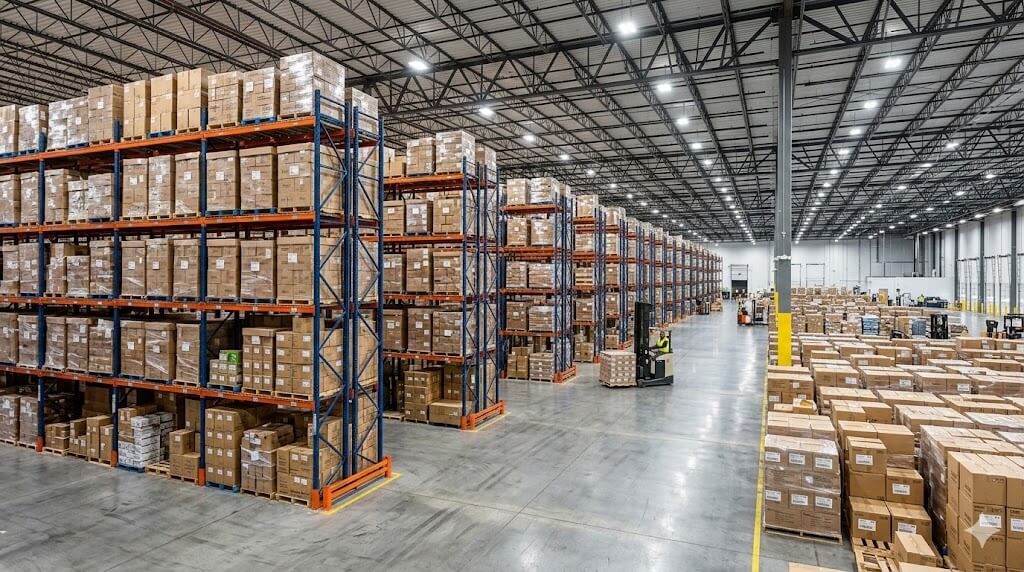
How to Choose the Right Pallet Racking System for Your Warehouse
January 20, 2025
Warehouse space is expensive—every square foot counts. Whether you’re leasing 50,000 square feet in Sanford or running a 200,000-square-foot distribution center in Orlando, maximizing your storage capacity directly impacts your bottom line.
Here’s the problem: choosing the wrong pallet racking system leads to wasted vertical space, operational inefficiencies, safety hazards, and ultimately higher costs. A system that works for a food distributor with high turnover and strict FIFO requirements won’t work for a manufacturing facility storing bulk materials with low SKU counts.
The right racking system depends on your unique warehouse characteristics—ceiling height, product weight, inventory turnover, and the forklifts you use. In this guide, you’ll learn about the six main types of pallet racking, the critical factors that determine which system fits your needs, and the costly mistakes to avoid.
Types of Pallet Racking Systems
Not all racking is created equal. Here are the six main types and when to use each one.
1. Selective Pallet Racking (Single Deep)
What it is: The most common type of pallet racking, offering direct access to every pallet position.
Best for: Warehouses with high SKU counts, FIFO inventory management, and general-purpose storage.
Pros: Maximum selectivity (you can reach any pallet without moving others), easy to install, and the lowest upfront cost. It’s the workhorse of warehouse storage.
Cons: Lower storage density compared to high-density systems, and it requires more aisle space to accommodate forklifts.
2. Double Deep Racking
What it is: Two rows of selective racks positioned back-to-back, accessible with specialized reach trucks.
Best for: Operations with medium SKU counts that need higher density than selective racking but still want decent accessibility.
Pros: Increases storage density by approximately 40% and reduces the amount of aisle space required.
Cons: Requires specialized reach trucks, operates on a LIFO (last-in, first-out) basis, and reduces selectivity since you can’t access the back pallet without moving the front one.
3. Drive-In / Drive-Through Racking
What it is: Forklifts drive directly into the rack structure to store and retrieve pallets along rails.
Best for: Low SKU count, high-volume storage applications like cold storage or bulk goods warehousing.
Pros: Highest storage density available (up to 85% space utilization), making it excellent for storing large quantities of the same SKU.
Cons: Drive-in operates on LIFO; drive-through offers FIFO but requires access from both sides. Access is slower, and selectivity is minimal.
4. Pushback Racking
What it is: Pallets are stored on nested carts that slide backward on inclined rails as new pallets are loaded from the front.
Best for: Medium SKU counts with LIFO inventory, storing 2-5 pallets deep per lane.
Pros: Higher density than selective racking with easier loading than drive-in systems.
Cons: LIFO only, requires level floors for smooth cart operation, and has a higher upfront cost than selective racking.
5. Pallet Flow (Gravity Flow) Racking
What it is: Pallets are loaded from the back and flow forward on sloped rollers or wheels, allowing picking from the front.
Best for: FIFO inventory with high turnover rates—ideal for perishables, food distribution, and time-sensitive products.
Pros: Excellent for FIFO operations, reduces forklift travel time, and increases throughput.
Cons: Higher cost than selective or pushback systems, and requires dedicated space for both loading and picking aisles.
6. Cantilever Racking
What it is: Racks with no front columns—load-bearing arms extend from a central vertical support.
Best for: Storing long, bulky items like lumber, pipes, furniture, steel bars, or non-palletized loads.
Pros: Ideal for oversized or awkward items, fully accessible from the front.
Cons: Not suitable for standard pallets, and lower weight capacity per level compared to pallet racking.
Understanding these options is the first step. Now let’s look at the factors that determine which system is right for your operation.
Key Factors to Consider When Choosing a Racking System
Your warehouse is unique. These critical factors will guide your decision.
Ceiling Height and Vertical Space
Your ceiling height determines how many rack levels you can install—and how much storage capacity you can unlock.
Standard selective racks typically reach 16-20 feet, but with specialized forklifts (reach trucks or order pickers), you can go 40 feet or higher. The key is maximizing cubic storage, not just square footage.
Rule of thumb: Leave 12-18 inches of clearance above the top pallet for fire sprinkler compliance.
Example: A 50,000-square-foot warehouse with a 30-foot ceiling can accommodate 4-5 rack levels, potentially adding 10,000+ pallet positions compared to a facility with only 16-foot ceilings and 2-3 levels.
Product Weight and Dimensions
Beam capacity ratings matter. Selective racks typically support 2,500-5,000 pounds per beam level, but heavier loads require more robust uprights and beams.
Pallet size also plays a role. Most warehouses use standard GMA pallets (48″ x 40″), but if you’re handling custom sizes, uneven loads, or oversized items, you may need cantilever racks or customized configurations.
Critical safety note: Never exceed posted load capacity. Overloading causes structural failure and OSHA violations. Always account for dynamic (moving) versus static (resting) load ratings.
Inventory Turnover Rate and SKU Count
How fast your products move—and how many different SKUs you manage—determines the best racking type.
- High SKU count + high turnover = Selective racking (you need frequent access to all items)
- Low SKU count + high volume = Drive-in or pushback racking (maximize density over selectivity)
- FIFO required (food, pharma, perishables) = Pallet flow or drive-through racking
- LIFO acceptable (long shelf life, bulk goods) = Drive-in, pushback, or double deep racking
Match your system to how fast products move and how often you need to access specific pallets.
Forklift Type and Aisle Width
Your forklift type determines minimum aisle width, which directly impacts how much racking you can fit.
- Counterbalance forklifts: 12-13 feet aisles (selective racking)
- Reach trucks: 8-10 feet aisles (double deep or taller selective)
- Narrow aisle forklifts: 6-7 feet aisles (specialized selective)
- Very narrow aisle (VNA): 5-6 feet aisles (wire-guided systems)
Tighter aisles mean more storage space—but they require specialized (and expensive) forklifts. Consider whether it makes sense to invest in new equipment or design your layout around existing forklifts.
Common Mistakes to Avoid
Even experienced warehouse managers make these costly errors.
1. Choosing Based on Cost Alone
The cheapest racking system upfront isn’t always the lowest total cost of ownership. The wrong system leads to operational inefficiency, lost productivity, and potential safety issues.
Factor in long-term ROI: labor costs, space utilization, and throughput. A slightly more expensive system that improves efficiency can pay for itself in months.
2. Ignoring Future Growth
Warehouse needs change. Plan for expansion now, or you’ll pay for it later.
Modular racking systems allow for reconfiguration as your inventory mix evolves. Don’t lock yourself into a rigid layout that can’t adapt when your business grows or your product lines shift.
3. Overlooking Weight Capacity and Load Distribution
Overloading is a leading cause of rack collapse. Always post load capacity labels (it’s an OSHA requirement), and train your team on proper loading techniques.
Best practice: Place heavier items on lower levels to lower the center of gravity and improve stability.
4. Inadequate Training for Warehouse Staff
Forklift operators need training specific to the racking system they’re working with. Without proper training, you’ll see damage to racks, inventory, and an increased risk of injuries.
Document all training and conduct regular refresher courses.
5. Skipping Professional Installation or Inspection
DIY installation or hiring unqualified installers creates safety hazards. Racks must be anchored properly, installed level, and built to manufacturer specifications.
Annual professional inspections are recommended per OSHA and RMI (Rack Manufacturers Institute) guidelines. Don’t skip them.
6. Not Planning for Aisle Layout and Workflow
Poor aisle layout wastes time and creates bottlenecks. Consider traffic flow: one-way versus two-way aisles, receiving versus shipping zones, and how to optimize pick paths to minimize forklift travel distance.
Next Steps: Get Expert Guidance
Choosing the right pallet racking system requires understanding your space, inventory, equipment, and workflow. It’s not a one-size-fits-all decision.
Working with experienced professionals who understand warehouse optimization makes the difference between a system that works and one that costs you money every day.
Titan Material Handling specializes in designing and installing warehouse systems throughout Central Florida. From selective racking to high-density drive-in systems, we help businesses maximize space, improve safety, and boost efficiency.
Not sure which pallet racking system is right for your warehouse? We offer free consultations and expert installation. Get a free quote today and start maximizing your warehouse efficiency.
Need Help Maximizing Your Warehouse Space?
Our team designs custom racking and mezzanine solutions that fit your operation. Get a free layout and quote—typically delivered within 48 hours.