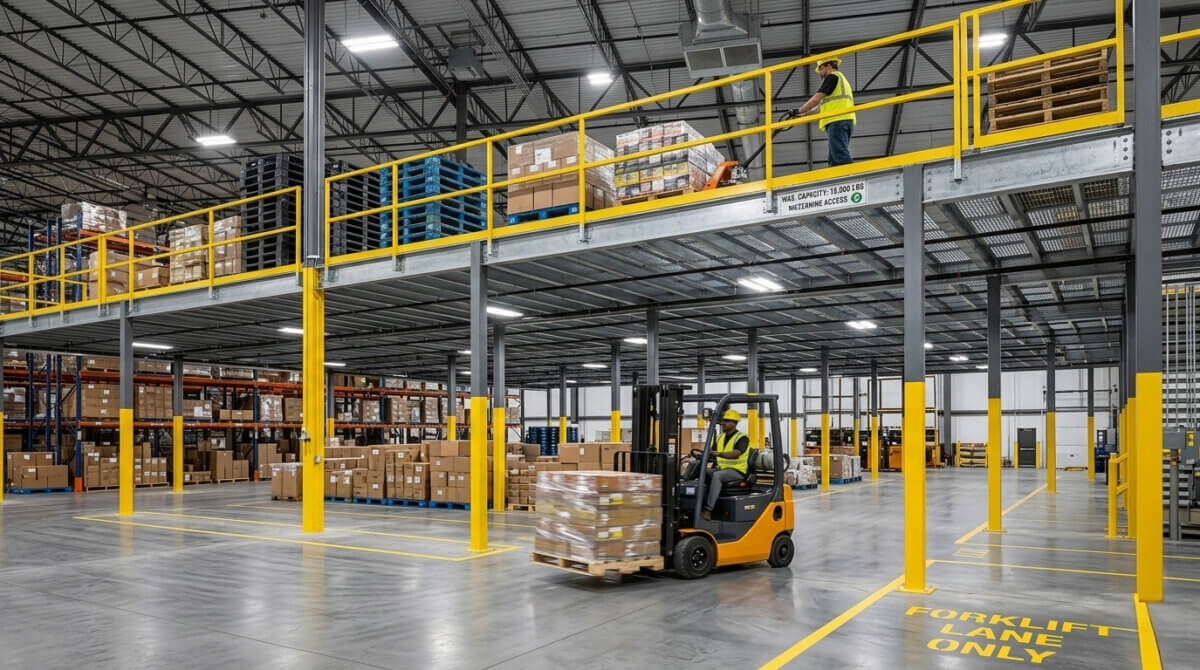
Warehouse Mezzanine ROI: Is Expanding Up More Cost-Effective Than Moving?
April 17, 2026
When your warehouse hits 85% capacity, every decision becomes critical. Do you sign a new lease across town? Break ground on an addition? Or look up and realize the solution might be right above your head? Understanding warehouse mezzanine ROI can mean the difference between a six-figure relocation headache and a strategic investment that pays for itself in under three years.
For warehouse managers and operations directors across Central Florida and the Southeast, the “expand up” option is becoming the smart money choice. Here’s why.
When Growing Warehouse Capacity Becomes Critical
Most warehouse operators know the warning signs before they crunch the numbers. Aisles get narrower as pallets encroach on travel paths. Receiving backs up because there’s nowhere to stage new inventory. Safety incidents tick upward as workers navigate increasingly cramped conditions.
When utilization creeps past 85%, you’ve entered the danger zone—not just operationally, but financially. At this point, you’re facing three expansion paths:
- Relocate to a larger facility
- Build out with new construction
- Build up with a mezzanine system
The choice you make today locks in costs, operational disruption, and competitive positioning for the next decade. Given current commercial real estate pressures and the operational risk of moving, more facilities are discovering that vertical expansion isn’t just viable—it’s optimal.
Understanding Mezzanine ROI vs. Traditional Expansion
The True Cost of Warehouse Relocation
Moving to a new facility sounds straightforward until you tally the real expenses. For a mid-size warehouse operation, relocation costs typically run $200,000 to $500,000 or more when you factor in:
- Physical moving expenses and equipment transfer
- Business interruption during the transition
- New lease deposits, tenant improvements, and potentially higher rent
- Lost productivity as staff learns new workflows
- Customer service disruptions and potential lost business
- The timeline? Expect 6-12+ months from decision to full operational capacity.
Beyond the hard costs, there’s the operational risk. Any warehouse manager who’s lived through a move can tell you: things break, inventory gets misplaced, and customer shipments suffer.
Building Expansion: When It Makes Sense (and When It Doesn’t)
Ground-up construction gives you exactly what you want—at a premium. Current construction costs in the Southeast run $100-$200 per square foot, plus the permitting and zoning headaches common in Central Florida’s growing markets.
Timeline stretches to 12-18 months. And you’re permanently locked into that footprint, whether your needs grow or shrink.
Construction makes sense when you own the property, have excess land, and plan to stay for 15+ years. For everyone else, it’s an expensive commitment.
Mezzanine Investment Breakdown
Here’s where the numbers get interesting. A professionally installed warehouse mezzanine typically costs $40-$80 per square foot—roughly 20-30% of relocation costs and half the price of new construction.
More importantly? Installation takes 4-8 weeks, not 12+ months. Your operation continues running while crews work during off-hours. And you’re doubling your usable square footage without touching your building footprint.
Real ROI: How Mezzanines Pay for Themselves
Space Utilization Gains
Most warehouses use only 22-27% of their available cube space. A mezzanine converts that vertical air into functional real estate—storage, offices, production areas, or assembly space.
Typical capacity increases range from 40-100% without expanding your building footprint. One client we worked with in Sanford added 4,400 square feet of production space above their existing warehouse floor, pushing their cube utilization from 28% to 52%.
Operational Cost Savings
The financial benefits compound over time:
- Avoid increased rent: Florida warehouse space runs $8-15 per square foot annually. Doubling your usable space without doubling your lease is immediate savings.
- Reduced travel time: Better-organized inventory zones cut pick times.
- Lower insurance costs: Single-site operations cost less to insure than multi-site logistics.
Revenue Protection
Unlike relocation, mezzanine installation creates zero business interruption. Your customers never know construction is happening. You maintain service levels while adding capacity to handle growth.
For operations running lean margins, avoiding the revenue dip that accompanies relocation can be worth six figures alone.
ROI Calculator Framework for Your Facility
To calculate your specific warehouse mezzanine ROI, gather these variables:
Current facility costs:
– Monthly rent/mortgage payment
– Utilities and operating expenses
– Per-square-foot cost basis
Projected storage needs:
– Growth trajectory over next 3-5 years
– Seasonal peaks and safety stock requirements
Cost of downtime:
– Daily revenue impact if operations halted
– Customer penalty clauses or lost business potential
Available vertical clearance:
– Ceiling height (14-24 feet is ideal)
– Structural load capacity assessment
Most mezzanine projects break even in 18-36 months when compared to relocation. After that, the additional capacity generates pure operational leverage.
Critical Factors That Impact Mezzanine ROI
Structural Requirements
Not every building is mezzanine-ready. You’ll need:
- Adequate ceiling height (minimum 14 feet, ideally 18-24 feet)
- Floor load capacity sufficient for mezzanine footings
- Fire suppression and egress compliance planning
Titan’s project management and design team conducts structural assessments as part of every mezzanine consultation, ensuring your system meets OSHA compliance and load rating requirements.
Design Optimization
The best mezzanines serve multiple purposes. Storage above, offices below. Production space with integrated conveyor systems. Future expansion points built into the initial design.
CAD drawings and engineered documentation aren’t just paperwork—they’re your roadmap to maximizing square footage value.
Installation Quality & Permitting
Cutting corners on installation creates long-term liability. Properly engineered systems include stamped drawings, load certifications, and code compliance documentation. Single-source providers who handle design, permitting, and installation reduce the coordination risks that plague multi-vendor projects.
Southeast US Market Considerations
Florida warehouses face unique considerations. Building codes vary by municipality, and permitting timelines can stretch 6-10 weeks in high-growth areas. Hurricane-rated design considerations add structural requirements but protect your investment long-term.
Humidity control matters for certain mezzanine applications, particularly if you’re creating climate-sensitive storage or office space above warehouse floors. Regional expertise matters—these aren’t California or Texas warehouse conditions.
Making the Decision: Is a Mezzanine Right for You?
Run through this checklist:
- Building clearance exceeds 14 feet ✓
- You have a stable 3-5 year facility plan ✓
- You need capacity within 12 weeks, not 12 months ✓
- Business disruption is unacceptable ✓
- Your current utilization exceeds 80% ✓
If you checked four or more boxes, a mezzanine deserves serious consideration.
Ready to Calculate Your Warehouse Mezzanine ROI?
The difference between relocation and vertical expansion can be hundreds of thousands of dollars—and months of operational disruption. For warehouse managers in Central Florida and across the Southeast, the math increasingly favors building up.
At Titan Material Handling, we’ve helped facilities add thousands of square feet without adding a single square foot to their building footprint. From structural assessment and CAD design to permitting and professional installation, our warehouse systems team handles the complexity so you can focus on operations.